Medieval Tapestries: Woven Walls of Power and Prayer
The Art of the Woven Image
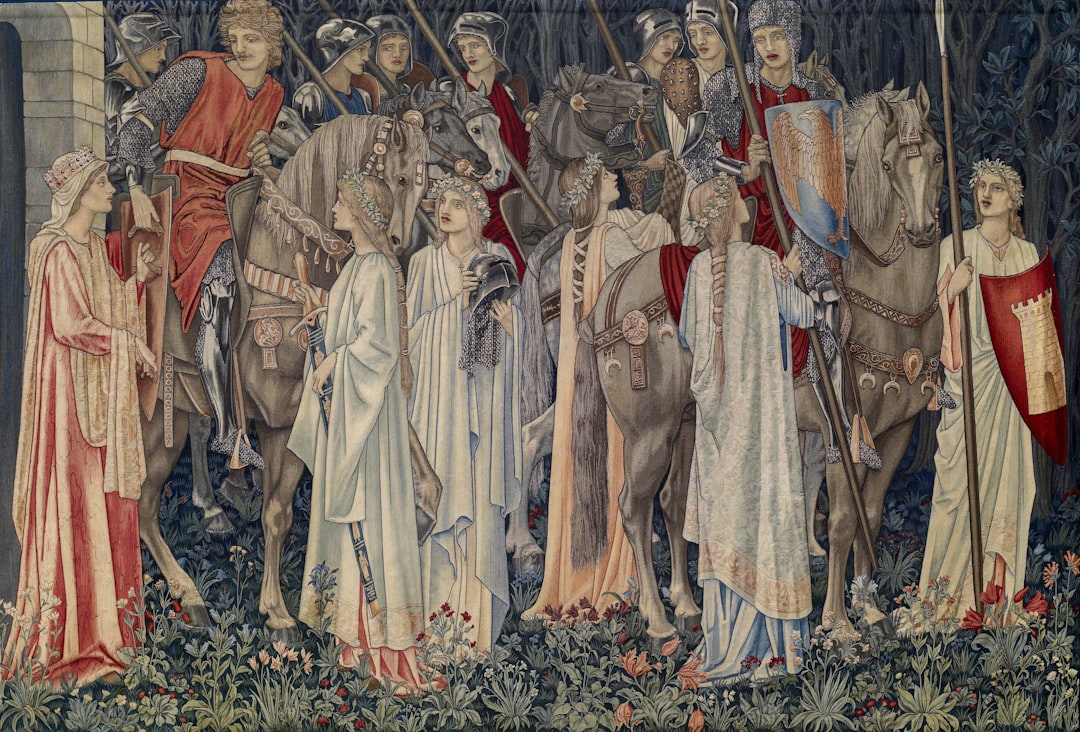
Tapestries were the most expensive and prestigious decorative medium of the late medieval period. Commissioned by kings, popes, and dukes, they hung in the great halls and chapels of castles and cathedrals, transforming cold stone walls into luminous surfaces of colored wool and silk. Unlike frescoes, which were fixed to a single building, tapestries could be rolled up and transported — making them the ideal medium for an itinerant court.
The Apocalypse Tapestry of Angers, commissioned by Louis I, Duke of Anjou, in 1375, is the largest surviving medieval tapestry cycle. Woven by Nicolas Bataille in Paris from designs attributed to the illuminator Hennequin of Bruges, the original tapestry measured approximately 140 meters in length and consisted of six panels, each about 24 meters wide and 5 meters high. The iconographic program illustrates the Apocalypse of Saint John, drawing on the commentary of Jean de Venette and incorporating contemporary political references — the Seven-Headed Beast of Revelation is widely interpreted as an allusion to the papal schism and the Hundred Years' War.
The Unicorn Tapestries
The Lady and the Unicorn series (Musee de Cluny, Paris) and the Unicorn Hunt tapestries (Metropolitan Museum of Art, New York) represent the most enigmatic and beloved tapestry cycles of the late Gothic period. Woven around 1500, probably in Brussels or Liege, the Lady and the Unicorn series consists of six panels, five of which depict a noblewoman with a unicorn representing the five senses (sight, hearing, smell, taste, and touch). The sixth panel, labeled 'A Mon Seul Desir' (to my only desire), shows the lady placing a necklace in a jeweled casket — an image that has been interpreted as a renunciation of the physical senses in favor of spiritual love, or conversely, as a declaration of free will.
The Unicorn Hunt tapestries, also dating to around 1500, tell a narrative of hunters pursuing a unicorn through a forest of flowering trees, eventually capturing it and killing it. The final panel shows the unicorn alive again in a walled garden with a pomegranate tree — a clear allusion to Christ's resurrection. The hortus conclusus (enclosed garden) motif derives from the Song of Songs and was widely understood as a symbol of the Virgin Mary's chastity, making the unicorn both a Christological and a Marian symbol.
Materials, Technique, and the Economics of Luxury
Tapestry weaving required specialized workshops that employed dozens of craftsmen working at multiple looms simultaneously. The weavers worked from a cartoon — a full-scale painted design on cloth or paper — placed behind or beneath the warp threads. Using wool for the background and silk or metallic threads for highlights, the weavers interwove colored weft threads through the warp, building up the image in horizontal bands. The density of the weave determined the quality: the finest tapestries had 8-10 weft threads per centimeter, while cheaper productions had 4-5.
The cost of a major tapestry cycle was astronomical. The Apocalypse Tapestry of Angers is estimated to have cost Louis of Anjou the equivalent of several years' income from his duchy. The Lady and the Unicorn series would have been affordable only to the highest echelon of European nobility. This economic reality explains why so few medieval tapestries survive — they were valuable enough to be cut up and reused when fashion changed, and many were destroyed during the French Revolution by being burned for the gold thread they contained.