There are books, and then there are objects that transcend the category of "book" entirely. The Book of Kells belongs to the latter. When you look at its pages — the explosive geometry of the chi-rho monogram, the carpet pages dense with interlaced patterns, the subtle humor of a cat stealing communion wafers in the margins — you are not simply looking at a medieval manuscript. You are looking at a work of art so ambitious, so laboriously crafted, and so visually overwhelming that it challenges everything we think we know about the so-called "Dark Ages."
The Book of Kells is an illuminated manuscript of the four Gospels — Matthew, Mark, Luke, and John — written in Latin and decorated with some of the most elaborate ornamental artwork ever produced in Western Europe. It was created around 800 CE, most likely by a community of Celtic monks at the monastery on the island of Iona, off the west coast of Scotland. After Viking raids killed 68 monks in 806 CE and disrupted the community, the manuscript was moved to the monastery at Kells in County Meath, Ireland, where it remained for centuries and from which it takes its modern name. Today, it is housed at Trinity College Dublin, where it is one of Ireland's most visited cultural treasures.
The Chi-Rho Page: A Single Letter, An Entire Universe
If any single page in the history of Western art could be said to encapsulate an entire civilization's aesthetic ambition, it would be folio 34r of the Book of Kells — the chi-rho monogram page. The chi-rho consists of the first two letters of the Greek word Christos (ΧΡ), and in this manuscript, these two letters have been expanded into a composition of staggering complexity, measuring approximately 37 centimeters by 27 centimeters — nearly the entire page.
The letters are so densely ornamented that they almost cease to be legible as letters at all. They dissolve into a universe of interlaced ribbons, spirals, animal forms, and geometric patterns. Tiny human heads peer out from between the curves. Angels stand guard at the edges. The initial P (rho) curls into itself with such intricate detail that viewers have spent centuries discovering new elements hidden within it. Art historians estimate that there are over 100 individual decorative elements on this single page.
This page introduces the text of Matthew 1:18 — "Now the birth of Jesus Christ was on this wise" — and the chi-rho page serves as a visual overture, announcing the arrival of Christ's story with a fanfare of gold, color, and pattern. It is, in every sense, the medieval equivalent of a "hero section" on a website: the moment that stops you cold and tells you that what follows is important.
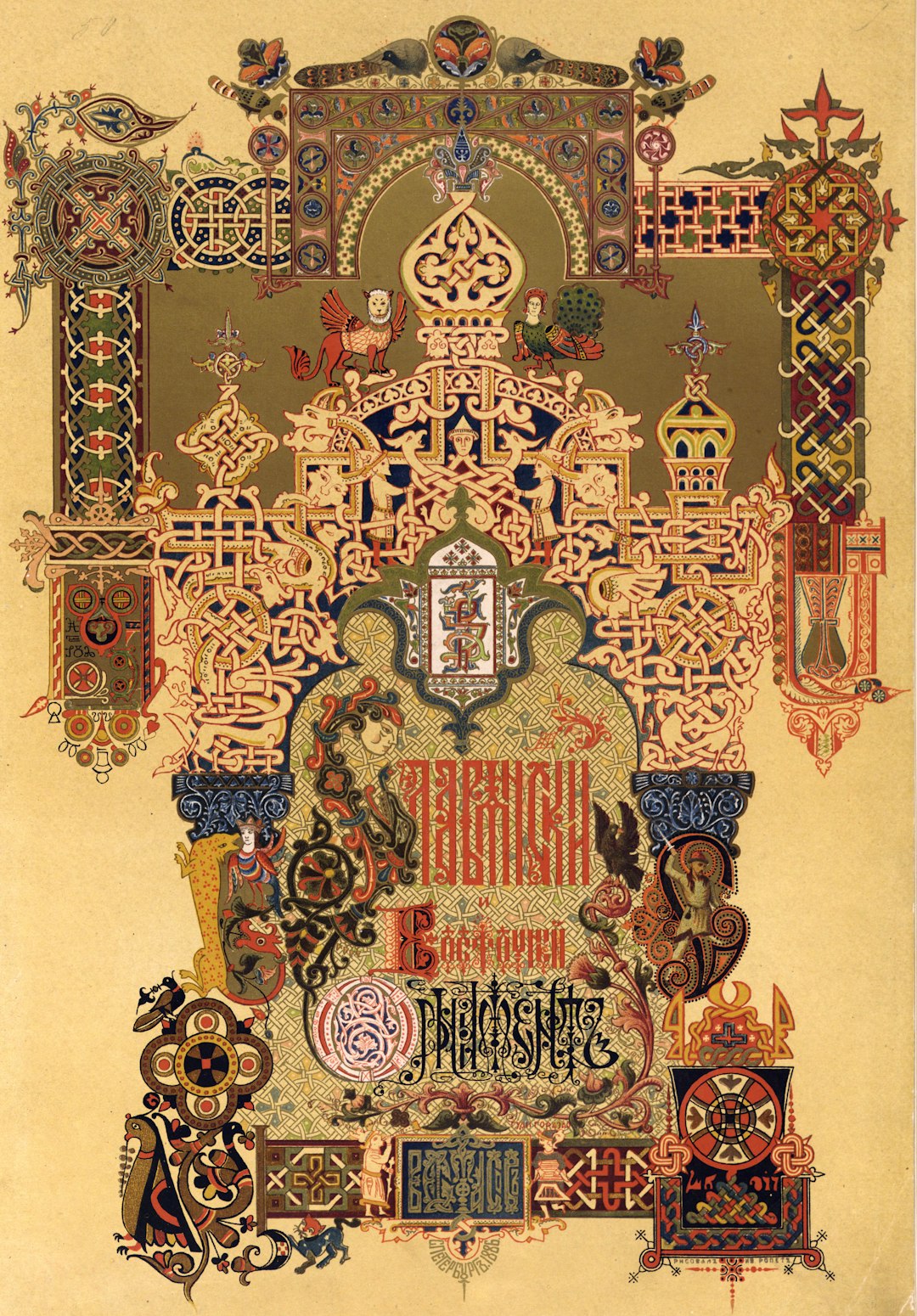
Gold-leaf illuminated manuscript page showing elaborate decorated initials and geometric patterns in the Insular tradition, c. 800 CE. Vellum, gold leaf, and mineral pigments. Public Domain.
Carpet Pages and the Geometry of Devotion
Scattered throughout the Book of Kells are pages that contain no text at all — only decoration. These are known as "carpet pages" because their dense geometric patterns resemble woven rugs. The designs draw on multiple artistic traditions: the interlaced knotwork of Celtic metalwork, the geometric precision of Coptic textiles, the spiral motifs of Pictish stone carving, and the animal-style ornamentation of Germanic art.
These pages are not merely decorative filler. They serve a theological and contemplative function. In a tradition that valued meditation and repetitive prayer, the carpet pages offered a visual analogue — patterns so complex that the eye could wander through them for hours, discovering new relationships and connections. They are, in a sense, visual prayers: works of art designed not to be "read" in the conventional sense, but to be contemplated.
The precision of these geometric designs is remarkable. The interlaced patterns maintain consistent widths and spacing throughout, suggesting that the scribes used ruling lines and compass constructions to lay out their designs before committing ink to vellum. This level of planning and execution required extraordinary mathematical skill as well as artistic talent.
Hidden Details and Monastic Humor
For all its theological seriousness, the Book of Kells is not without humor. Hidden among the elaborate decorations are small, delightful details that reveal the personality of its creators. A cat called Pangur Bán — "White Pangur" — is mentioned in a gloss written on the margins of another manuscript from the same monastery, and the monks' fondness for animals extends into the Kells itself: mice are depicted stealing communion wafers, and an otter is shown eating a fish. These small touches suggest that the monks who created this masterpiece were not humorless ascetics but real people with a sense of play, who found joy in the act of creation even as they served God through their labor.
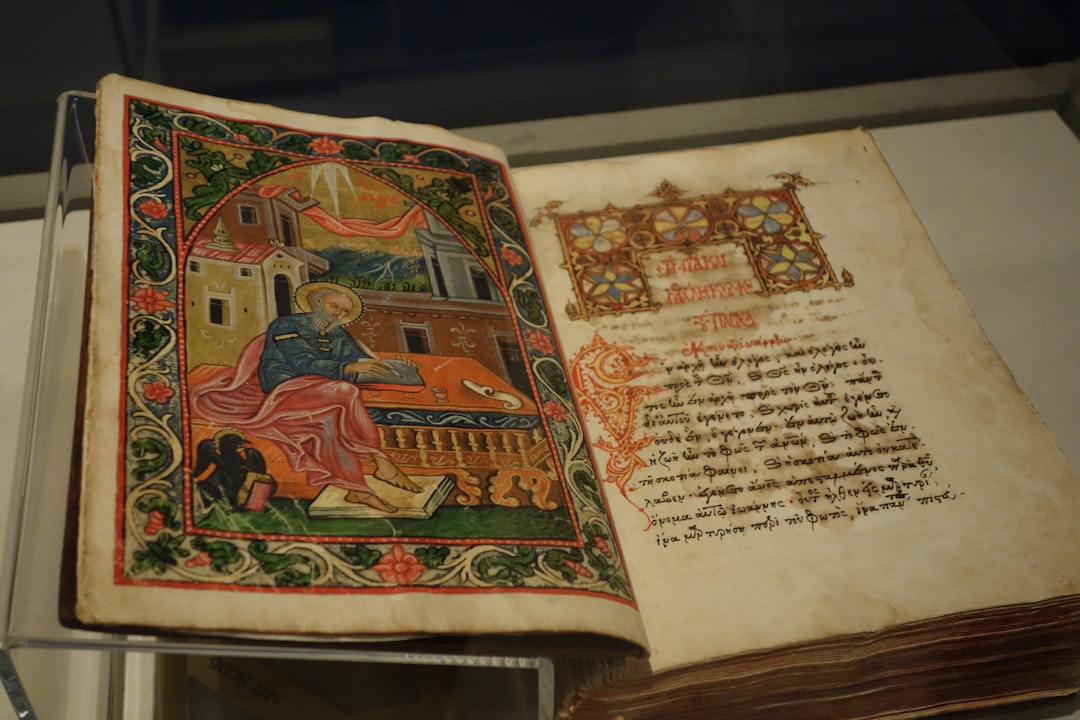
Illuminated manuscript page featuring a decorated initial with interlaced knotwork and Latin text, in the Insular artistic tradition, c. 800 CE. Vellum and mineral pigments. Public Domain.
The Technology of Book-Making: 185 Calves and a Global Supply Chain
The creation of the Book of Kells was an industrial-scale operation by early medieval standards. The manuscript contains 185 vellum folios (370 pages), each made from the calfskin of a single calf. That means approximately 185 calves were slaughtered to produce the raw material for this single book. The vellum had to be prepared through an elaborate process of soaking, scraping, stretching, and drying — a skilled craft that required specialized knowledge and considerable time.
The manuscript is organized into quires — gatherings of multiple folded sheets sewn together. Each quire typically contained several folios, and the scribes worked on these quires as units, with different hands (different individual scribes) contributing to different sections. The ruling lines that guided the text were made with a dry point or a lead stylus, and the scribes practiced a remarkably consistent Insular majuscule script — a letterform that is elegant, legible, and extraordinarily disciplined.
The pigments used in the Book of Kells reveal an astonishing international trade network. The deep blue is lapis lazuli, a mineral sourced from mines in what is now Afghanistan — an extraordinary rarity in early medieval Britain and Ireland, where it would have been more valuable than gold. The yellow is orpiment (arsenic sulfide), the red is red lead, and the manuscript also contains woad (a plant-based blue dye), verdigris (a copper-based green), and gold leaf. These materials were traded across Europe, the Mediterranean, and beyond, suggesting that the Iona monastery was connected to a vast commercial network that stretched from the British Isles to the Hindu Kush.
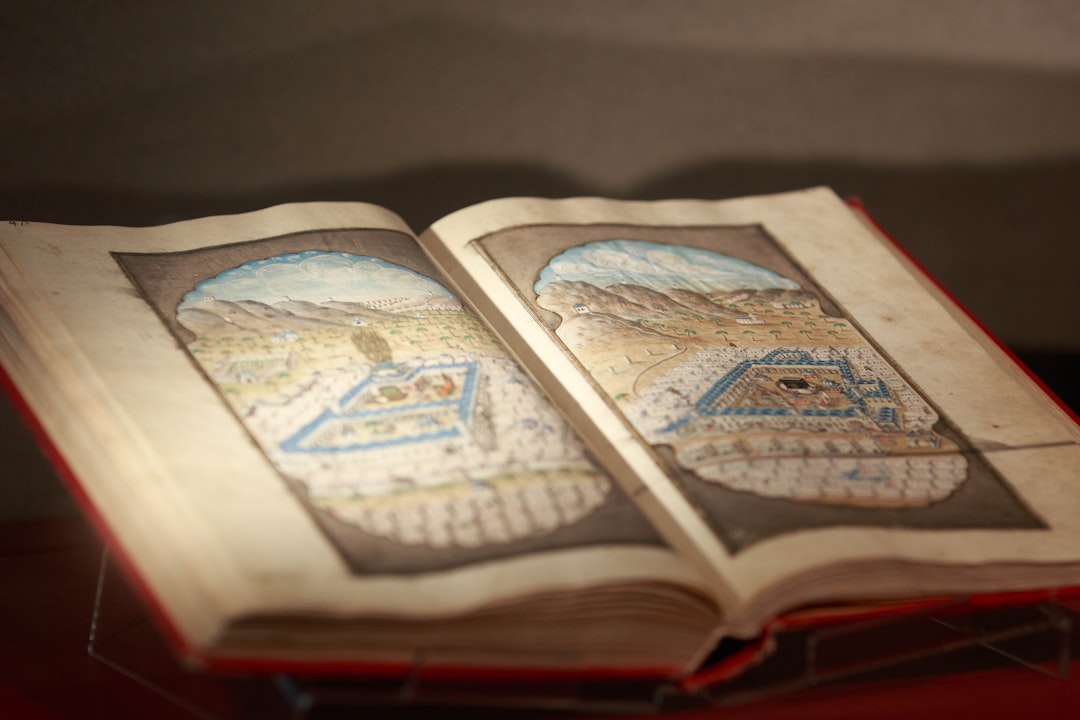
Medieval monk or scribe engaged in the painstaking work of copying and illuminating a manuscript, illustrating the monastic tradition of book production, c. 800 CE. Illumination. Public Domain.
The Viking Raids and the Unfinished Mystery
One of the most intriguing questions about the Book of Kells is why it was never fully completed. Several pages show signs of being left unfinished — text blocks where the decoration was never added, spaces where planned illustrations never materialized. The most likely explanation is the Viking raid of 806 CE, in which Norse raiders attacked the monastery at Iona and killed 68 monks. This catastrophic event disrupted the monastic community and almost certainly interrupted the production of the manuscript.
After the raid, the surviving monks relocated to Kells in Ireland, bringing the partially completed manuscript with them. The work may have continued at Kells, but perhaps with fewer skilled scribes, less access to the expensive pigments that Iona's trade connections had provided, or simply a lower priority in a community recovering from trauma. The result is a manuscript that is simultaneously one of the most complete and one of the most incomplete artworks of the medieval period — a masterpiece that, in a strange way, was interrupted by the very forces of violence and chaos that its beauty sought to transcend.
A Living Document
The Book of Kells has survived over 1,200 years of history. It was stolen in 1007 (the Annals of Ulster record that "the great Gospel of Colum Cille, the chief relic of the Western World, was wickedly stolen during the night") and recovered two months later, its cover torn off but its pages intact. It was rebound multiple times, most recently in 1953, and has been digitized in its entirety by Trinity College Dublin and the Dublin Institute for Advanced Studies, making it freely accessible online.
What makes the Book of Kells extraordinary is not just its beauty, but what it represents: the conviction, held by a small community of monks on a remote island at the edge of the known world, that beauty itself was a form of worship — that every letter, every line, every fleck of gold was an act of devotion. In a world that often associates the early Middle Ages with ignorance and decline, the Book of Kells stands as irrefutable evidence of a civilization capable of producing art of the highest order.