Charlemagne and the Carolingian Renaissance
When Charlemagne was crowned Emperor of the Romans by Pope Leo III on Christmas Day in the year 800, he became the ruler of the largest political entity in Western Europe since the fall of the Western Roman Empire. His reign (768–814) and the period that followed saw a remarkable flourishing of artistic and intellectual activity now known as the Carolingian Renaissance.
Charlemagne understood that imperial power required cultural as well as military strength. He assembled a court of scholars from across Europe — Alcuin of York from England, Theodulf of Orléans from Spain, Paul the Deacon from Lombardy, and Einhard from the Rhineland — and charged them with reforming education, standardizing religious texts, and creating art that would express the grandeur of the renewed Roman Empire. This deliberate program of cultural renewal had a profound impact on the visual arts.
Carolingian art is characterized by its self-conscious revival of classical Roman and early Christian models, combined with the vitality of Northern European artistic traditions. The result was a hybrid style that looked backward to antiquity while forging a new visual language for medieval Europe.
The Palatine Chapel at Aachen
The architectural centerpiece of Charlemagne's reign is the Palatine Chapel in Aachen (Aix-la-Chapelle), built between approximately 792 and 805 by the architect Odo of Metz. The chapel was part of a larger palace complex and served as Charlemagne's private place of worship and the ceremonial center of his court.
The chapel's design was directly inspired by the Byzantine church of San Vitale in Ravenna, which Charlemagne had visited. The octagonal plan, with a central space surrounded by an ambulatory and gallery, creates a unified, domed interior that was unprecedented in Western Europe north of the Alps. The use of spolia — columns and marble brought from Rome and Ravenna — reinforced the connection to the imperial past.
The chapel's interior decoration, including mosaics, marble revetment, and bronze railings, reflected the wealth and ambition of Charlemagne's court. Although much of the original decoration has been lost or replaced, the structure itself remains one of the most important surviving buildings of the Carolingian period and a UNESCO World Heritage Site.
Illuminated Manuscripts: The Carolingian Scriptoria
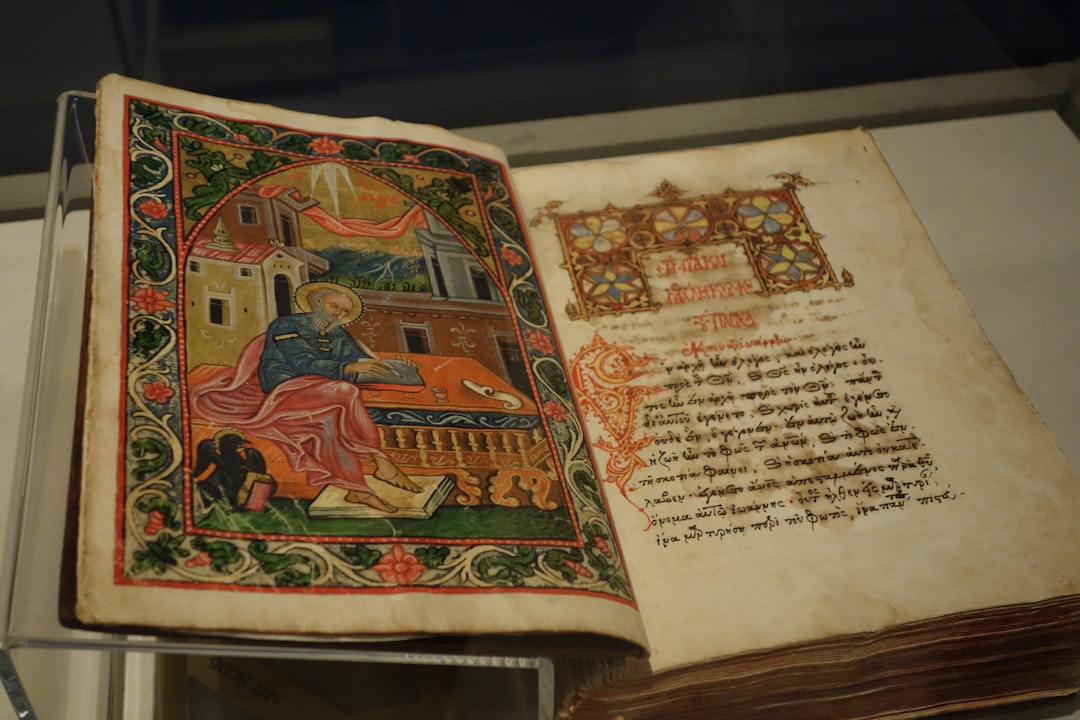
The most significant surviving body of Carolingian art is found in illuminated manuscripts. Charlemagne and his successors established scriptoria (manuscript workshops) in monasteries and cathedral schools throughout the empire, producing books of extraordinary quality. These manuscripts fall into several distinct groups, each associated with a particular center of production.
The Coronation Gospels (also known as the Vienna Coronation Gospels, c. 800 CE) represent the most classicizing approach. Its evangelist portraits are painted in a naturalistic style derived from late antique models, with convincing spatial settings and individualized figures. This manuscript was reportedly found in Charlemagne's tomb when it was opened by Emperor Otto III in the year 1000.
The Ebbo Gospels (c. 816–835 CE), produced at the monastery of Hautvillers near Reims, present a dramatically different aesthetic. The evangelist portraits are rendered with energetic, almost feverish brushwork that creates a sense of inspired frenzy. The figures seem to vibrate with spiritual energy, a quality that distinguishes the Reims school from other Carolingian workshops.
The Utrecht Psalter (c. 820–830 CE), also from Reims, is perhaps the most influential of all Carolingian manuscripts. Its 166 pen-and-ink illustrations, drawn in a rapid, sketchy style, accompany the psalms and canticles. Each illustration is a complex composition that translates the metaphors of the psalm text into vivid narrative imagery. The Utrecht Psalter was copied repeatedly in later centuries and had a lasting influence on medieval illustration.
The Lorsch Gospels (c. 778–820 CE) are notable for their treasure binding — an ivory cover depicting the Virgin Mary, Christ, and the saints, framed by metalwork inlaid with gems. The manuscript's canon tables are decorated with architectural frames that echo the classical architecture of the Palatine Chapel, demonstrating the coherence of Carolingian artistic vision across different media.
Ivory Carving and Metalwork
Carolingian artisans also excelled in the luxury arts of ivory carving and metalwork. Ivory book covers, diptychs, and small plaques were produced in court workshops and major monastic centers. The Carolingian ivory carvers drew on late antique consular diptychs and early Christian sarcophagi for their compositional models, adapting classical figure types to Christian subjects.
Metalwork of the Carolingian period includes liturgical vessels, reliquaries, and book covers decorated with gold, silver, gems, and enamel. The Altar of San Ambrogio in Milan (c. 824–859 CE), commissioned by Archbishop Angilbert II, is one of the finest surviving examples, featuring gold and gilt-silver reliefs depicting scenes from the life of Christ and St. Ambrose.
Carolingian Minuscule
One of the most enduring legacies of the Carolingian Renaissance was the development of Carolingian minuscule, a standardized script that replaced the diverse and often difficult-to-read regional scripts of the early Middle Ages. Developed under the direction of Alcuin of York at the Abbey of St. Martin in Tours, Carolingian minuscule featured clear, uniform letterforms with consistent spacing between words. This script became the standard book hand throughout Europe and is the direct ancestor of the lowercase letters used in modern printing and digital typography.
Integration of Insular and Mediterranean Traditions
Carolingian art represents a unique synthesis of artistic traditions. The Insular art of the British Isles — exemplified by manuscripts such as the Book of Kells and the Lindisfarne Gospels — contributed intricate interlace patterns, carpet pages, and the integration of text and image in ways that influenced Carolingian manuscript decoration. Meanwhile, the Mediterranean traditions of late antique Rome and Byzantium provided models for figural representation, architectural design, and mosaic decoration.
This integration was not merely decorative but reflected a deeper cultural project: the creation of a unified Christian European culture that drew on the best of both Northern and Mediterranean heritage. The Carolingian achievement laid the foundations for the artistic developments of the Romanesque and Gothic periods that followed.
Characteristics of Carolingian Art
- Revival of classical forms: Carolingian artists deliberately imitated Roman and early Christian models, producing a classicizing style seen in architecture, sculpture, and manuscript illumination.
- Naturalistic figure painting: Some Carolingian workshops, particularly at the court school in Aachen, achieved a degree of naturalism not seen in Western art since late antiquity.
- Narrative illustration: Manuscripts such as the Utrecht Psalter demonstrate a sophisticated approach to visual narrative, translating complex texts into coherent pictorial sequences.
- Integration of traditions: Carolingian art combines Insular decorative patterns, Mediterranean figural styles, and Germanic metalwork techniques into a cohesive artistic vision.
- Imperial symbolism: Art produced for Charlemagne's court served political as well as religious purposes, reinforcing the ideology of the renewed Roman Empire.
Related Reading
- → The Most Beautiful Book in the World: Inside the Book of Kells — The Insular manuscript tradition that influenced Carolingian art.
- → Romanesque Art (10th–12th Century) — The artistic tradition that followed the Carolingian period.
- → Early Christian Art (2nd–6th Century) — The classical models that Carolingian artists sought to revive.
- → Byzantine Art (4th–15th Century) — The Eastern Roman tradition that inspired Carolingian architecture.
Frequently Asked Questions
References
Beckwith, John. Early Medieval Art: Carolingian, Ottonian, Romanesque. Thames & Hudson, 1964.
McKitterick, Rosamond. The Carolingians and the Written Word. Cambridge University Press, 1989.
Nees, Lawrence. A Tainted Mantle: Hercules and the Classical Tradition at the Carolingian Court. University of Pennsylvania Press, 1991.
Sullivan, Richard E. Carolingian Scholarship and the Carolingian Renaissance. Michigan State University Press, 1976.
Wittkower, Rudolf. Architectural Principles in the Age of Humanism. 4th ed., Academy Editions, 1998.