On the night of June 10, 1194, a fire swept through the town of Chartres in northern France, destroying most of the Romanesque cathedral that had stood on the hill for nearly two centuries. The townspeople were devastated — but when they entered the ruins the next morning, they discovered that one thing had survived: the crypt containing the cathedral's most sacred relic, the Sancta Camisia, believed to be the tunic worn by the Virgin Mary at the birth of Christ. This was interpreted as a sign — the Virgin wanted a new, greater church built in her honor. And so began the construction of what would become one of the greatest achievements of Gothic architecture.
The new cathedral was built between 1194 and 1220 — an astonishingly short period for a building of this scale and complexity. It was funded not by a single patron but by the entire community: nobles donated generously, merchants contributed profits, and even peasants carted stones up the hill in a spirit of collective devotion. What they built was not just a church but a revolution in the understanding of space, light, and the relationship between architecture and theology.
The Secret of Chartres Blue
The most famous feature of Chartres Cathedral is its glass — specifically, the extraordinary blue that appears in many of its windows. Known as bleu de Chartres or "Chartres Blue," this is a deep, luminous cobalt blue that is unlike any other blue in stained glass, medieval or modern. Its exact chemical composition has never been replicated, and it remains one of the great unsolved mysteries of medieval technology.
The prevailing theory is that the blue was created by adding cobalt oxide to the glass melt, possibly in combination with wood ash from a specific type of tree — some researchers suggest beech or oak — whose mineral content interacted with the cobalt to produce a color of unique depth and intensity. The ash may have contained trace amounts of manganese, copper, or other elements that modified the blue in ways that pure cobalt alone cannot achieve. Whatever the precise formula, it was lost after the 13th century, and no subsequent glazier has been able to reproduce it.
The effect of this blue in the cathedral's interior is profound. On a sunny day, the light streaming through the blue glass transforms the stone interior into a space of shimmering, almost underwater luminosity. The blue seems to glow from within, as if the light itself has been colored by a divine hand. It is easy to understand why medieval worshippers experienced this as a direct encounter with the presence of God.
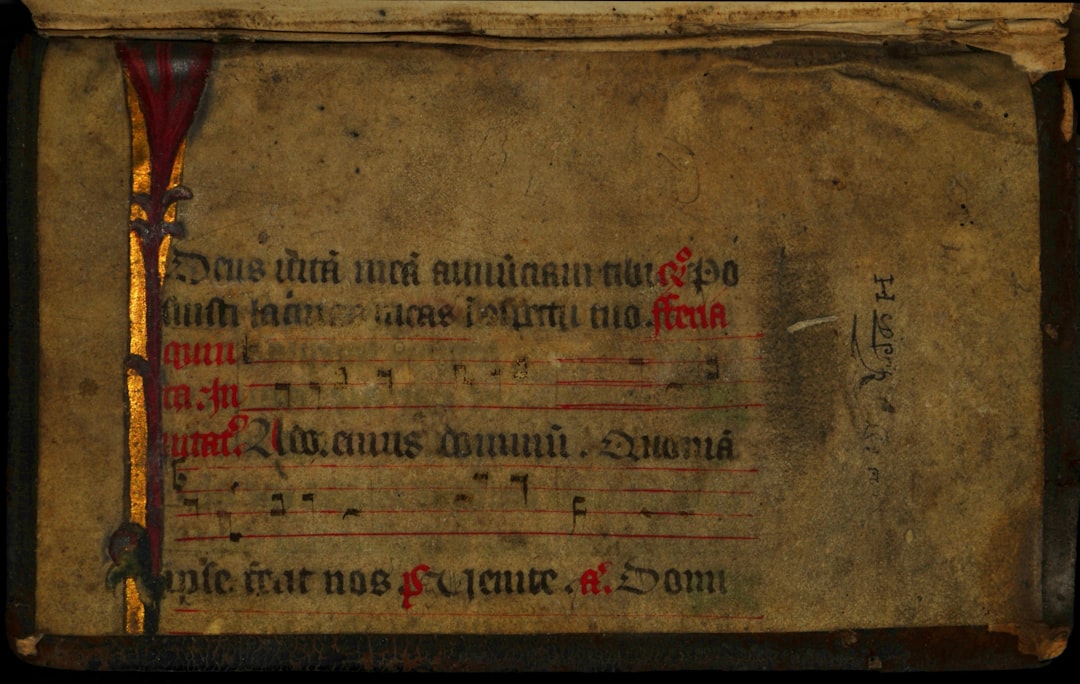
Medieval stained glass window featuring vibrant blue and red panels with biblical figures in the Gothic style, c. 1200-1230. Stained glass with cobalt and metallic oxide pigments. Public Domain.
176 Windows: The Complete Medieval Glass Ensemble
Chartres Cathedral contains 176 stained glass windows — by far the most complete medieval glass ensemble in the world. Most cathedrals lost the majority of their medieval glass to wars, iconoclasm, weather, and the "improvements" of later centuries. Chartres, remarkably, has retained over 80% of its original 13th-century windows. This makes it an irreplaceable document of medieval visual culture, theology, and artistic technique.
The windows tell stories — biblical narratives, the lives of saints, the legends of local martyrs. But they also depict the daily life of medieval Chartres: the windows funded by the guilds of the town include scenes of bakers, cobblers, wine merchants, water carriers, and carpenters at work. The donors are depicted in small panels at the bottom of the windows, kneeling in prayer — a permanent record of who paid for what, and a reminder that the cathedral was a communal project involving every stratum of society.
How Medieval Glaziers Made Glass
The process of creating stained glass in the Middle Ages was remarkably sophisticated. It began with silica sand (the base material), mixed with wood ash (which provided alkali as a flux), and heated in a furnace to approximately 1,500°C. Metallic oxides were added for color: cobalt for blue, copper for red and green, manganese for purple, iron for yellow and green. The molten glass was then blown or cast into sheets.
Details were painted onto the glass using vitreous paint — a mixture of ground glass, iron oxide, and a binding medium such as vinegar or urine — which was then fired in a kiln to fuse the paint permanently to the glass surface. The individual pieces were then assembled into compositions using strips of lead caming — H-shaped lead channels that held the pieces together and created the dark outlines characteristic of medieval stained glass. The entire panel was reinforced with iron bars (ferramenta) set into the stone window frames.
Romanesque stone carving detail from a cathedral portal showing elongated column statues bridging Romanesque stylization and Gothic naturalism, c. 1145-1155. Limestone sculpture. Public Domain.
The Royal Portal: Sculpture in Transition
Although the current cathedral is Gothic, the west facade retains the Royal Portal (Portail Royal) from the earlier Romanesque church, dating to approximately 1145-1155. This portal is one of the most important sculptural ensembles of the 12th century, and it occupies a crucial transitional position between the stylized, otherworldly figures of Romanesque art and the emerging naturalism of Gothic sculpture.
The column statues — elongated figures attached to the jambs (side posts) of the doorway — are both rigid and expressive. They are stretched vertically to conform to their architectural setting, their feet barely visible, their bodies wrapped in cascading drapery that emphasizes their verticality. Yet their faces are individualized: each figure has a distinct expression, a particular turn of the head, a unique relationship to the viewer. This combination of architectural constraint and human expressiveness is the hallmark of the Royal Portal and marks a turning point in the history of European sculpture.
The Cathedral Labyrinth: A Pilgrimage in Stone
Embedded in the floor of the nave is one of the most famous features of Chartres: the labyrinth. This is not a maze designed to confuse — it has no dead ends and no choices to make. It is a single, winding path of 294 stone segments that leads inevitably to the center. The path is approximately 261 meters long, and walking it on one's knees was considered a substitute for the pilgrimage to Jerusalem — a journey too expensive or dangerous for most medieval people.
The labyrinth's design is complex and mathematical. It consists of eleven concentric circuits arranged around a central rosette. The path alternates between moving toward and away from the center, creating a rhythm of approach and retreat that has been interpreted as a metaphor for the spiritual journey itself — the pilgrim's progress toward God, with its advances and setbacks, its moments of clarity and confusion. The center of the labyrinth was once covered by a copper plate (removed in 1790), and standing at the center, surrounded by the towering walls of the cathedral and the luminous blue of the windows above, the pilgrim experienced the culmination of their symbolic journey.
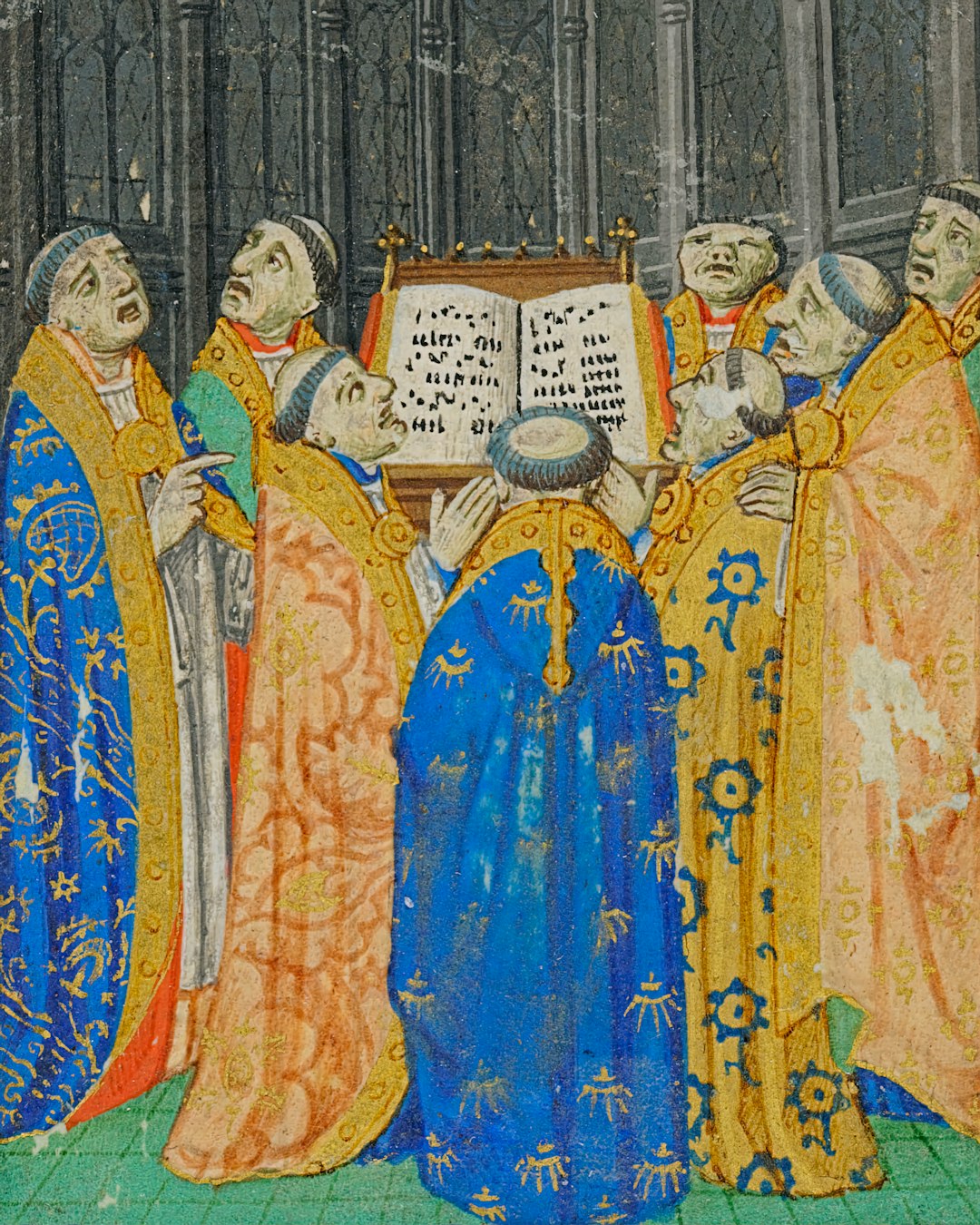
Medieval court scene depicting the nobility and clergy, reflecting the political and religious authority that funded great cathedral construction, 13th century. Illumination. Public Domain.
The North Rose Window: Power, Politics, and the Virgin
The North Rose Window, created around 1230, is one of the most politically significant artworks in the cathedral. It was a gift of Blanche of Castile, the powerful queen mother and regent for her son, Louis IX (later Saint Louis). The window depicts the Virgin and Child at its center, surrounded by Old Testament kings and prophets in the outer rings.
This is not merely a devotional image. It is a political statement. By placing the Virgin — the patron saint of Chartres — at the center of the royal rose window, and surrounding her with Old Testament kings, Blanche was making a visual argument about the legitimacy and divine favor of the French monarchy. Louis IX, still a young king, was being presented as the successor to the kings of Israel, ruling by divine right under the protection of the Virgin. The window is a masterpiece of political iconography, using the language of religious art to assert the authority of a specific royal dynasty.
The Theology of Light
To understand Chartres Cathedral, one must understand the medieval theology of light. The concept was articulated most clearly by Abbot Suger of Saint-Denis (c. 1081-1151), who oversaw the rebuilding of the Abbey Church of Saint-Denis — widely considered the first Gothic building. Suger believed that colored light was the physical manifestation of divine presence. The light streaming through stained glass was not merely illumination — it was God's presence made visible, a tangible connection between the material world and the spiritual realm.
This theology transformed architecture. Gothic builders did not merely want to make buildings that were well-lit; they wanted to make buildings in which light itself became the primary building material. They achieved this through structural innovations — pointed arches, ribbed vaults, and flying buttresses — that allowed walls to be thinned and pierced with vast expanses of glass. The wall ceased to be a solid barrier and became a framework for light. The Gothic cathedral is, in this sense, not a building at all but a machine for the production of colored light — a theological instrument designed to transform the experience of every person who entered it.
Chartres Cathedral is the supreme expression of this idea. Every element of its design — the proportions, the placement of windows, the specific colors of the glass, the relationship between interior space and exterior light — is calibrated to produce an experience of transcendence. Eight centuries later, it still works.