There are moments in art history when everything changes. Not gradually, not incrementally, but suddenly and completely — as if someone has opened a door that was always there but no one had thought to turn the handle. The frescoes of the Scrovegni (Arena) Chapel in Padua are one such moment. When Giotto di Bondone painted them around 1305, he did not merely improve upon the painting traditions that preceded him. He invented something that had never existed before: painted figures who feel.
The chapel was commissioned by Enrico Scrovegni, a wealthy banker from Padua. The commission was not driven by piety alone — it was driven by guilt, and perhaps by terror. Enrico's father, Reginaldo degli Scrovegni, was a notorious usurer whose exploitation of debtors was so infamous that Dante Alighieri placed him in the 7th circle of Hell in the Inferno (Canto XVII), among the violent against God and nature. Dante's judgment was not merely literary — it was theological, and it carried eternal consequences. Enrico commissioned the chapel on the site of a Roman arena (hence the alternative name "Arena Chapel") as an act of atonement — an attempt to cleanse his family's sin and secure his own salvation. The chapel was consecrated in 1305, though the frescoes may not have been fully completed until 1308.
Breaking from the Byzantine Manner
To understand what Giotto achieved, one must understand what he broke from. The dominant painting style in Italy in the late 13th century was the maniera greca — the "Greek manner," meaning the Byzantine style. Byzantine painting was characterized by flat, gold backgrounds, frontal and hieratic figures, stylized gestures, and a deliberate avoidance of naturalism. Figures were not meant to look like real people occupying real space; they were meant to look like icons — timeless, transcendent, removed from the physical world.
Giotto shattered this convention. His figures have weight and volume. They stand on the ground, not floating in a golden void. They occupy three-dimensional space, and the architecture and landscapes around them are rendered with a sense of depth that had never been attempted in Western painting. But the most radical innovation was emotional: Giotto's figures feel. They grieve, rage, embrace, and despair with an intensity that was entirely new. The Giorgio Vasari, writing in the 16th century, captured the essence of this transformation when he wrote that Giotto "brought back to light the art of painting that had been buried under the errors of Greek painters."
Dante, Giotto's contemporary, expressed the same sentiment in verse: "Cimabue thought he held the field in painting, and now Giotto has the cry, so that the fame of the former is obscure." Cimabue was Giotto's teacher (according to tradition), and he was considered the greatest painter of his generation — until Giotto surpassed him.
Early Christian fresco depicting a religious scene in the tradition that preceded Giotto's revolutionary naturalism, showing the flat, hieratic style of pre-Giotto painting, 4th-6th century. Fresco on plaster. Public Domain.
The Fresco Cycle: Three Registers of Sacred History
The fresco cycle covers the walls of the chapel in three horizontal registers (bands), read from top to bottom and from left to right. The upper register depicts the lives of Joachim and Anna, the parents of the Virgin Mary. The middle register tells the story of the life of the Virgin. The lower register presents the life of Christ. The west wall (the entrance wall) is dominated by a vast and terrifying Last Judgment, with Christ enthroned in majesty and the damned being dragged to hell.
Each scene is a self-contained composition, framed by painted architectural borders that create the illusion of windows opening onto the events depicted. The overall effect is of a continuous narrative — a visual history of salvation from the conception of Mary to the final judgment of all humanity. The frescoes are painted in buon fresco — pigment applied to wet plaster — which meant that Giotto had to work quickly and with absolute confidence, as the plaster absorbed the pigment permanently as it dried.
The Lamentation: Angels That Weep
Among the most celebrated of the Scrovegni frescoes is The Lamentation — the scene of Christ's body being mourned after his removal from the cross. The composition is deceptively simple: Christ's body lies in the foreground, held by his mother Mary, who bends over him with an expression of unbearable tenderness. Around them, the other figures — John the Evangelist, the Marys, and the disciples — express their grief through gestures that are specific, individualized, and deeply moving.
But the most extraordinary detail is in the sky: ten angels hover above the scene, and they are not serene or composed. They tear at their faces in grief. Their bodies contort, their arms flail, their mouths are open in screams of anguish. This is unprecedented in Western art. Angels had always been depicted as composed, ethereal beings, removed from human emotion. Giotto gives them the raw, unmediated grief of real mourners. The effect is devastating: if the angels in heaven are weeping, what hope is there for the humans below?
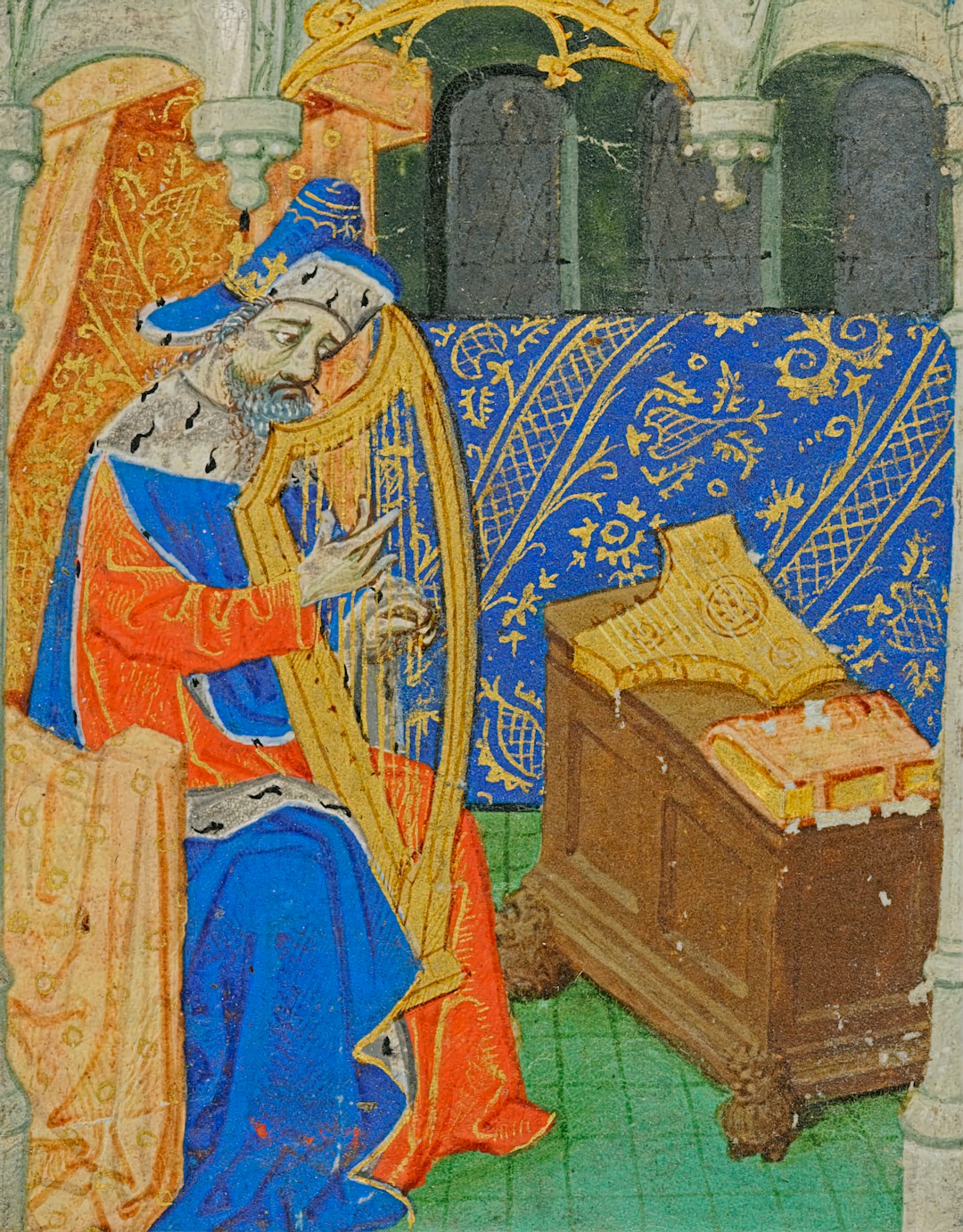
Medieval scholar writing in a scriptorium, reflecting the intellectual and theological tradition that shaped the narrative content of Giotto's fresco cycles, c. 1300. Illumination. Public Domain.
The Kiss of Judas: Calm Dignity Against Chaos
In The Kiss of Judas (also called The Arrest of Christ), Giotto creates one of the most dramatically powerful compositions in the entire cycle. The scene is a maelmoth of activity: soldiers press in from the right, their spears and halberds creating a forest of vertical lines. Judas embraces Christ, and his yellow cloak wraps around Jesus's body like a shroud — a visual metaphor for the betrayal that is simultaneously an embrace and an entrapment.
But in the center of this chaos, Christ is calm. His face is composed, his eyes meet Judas's with a look of sorrow rather than anger, and his posture is dignified. The contrast between the frantic energy of the soldiers and the stillness of Christ is one of the most powerful uses of compositional contrast in the history of art. Giotto understood that the emotional center of a scene is not necessarily where the most action is — it is where the stillness is.
The Meeting at the Golden Gate: The First Real Embrace
Perhaps the most tender scene in the chapel is The Meeting at the Golden Gate — the moment when Joachim and Anna, Mary's parents, embrace at the gate of Jerusalem after a period of separation. The two figures stand face to face, their arms wrapped around each other, their bodies pressed together in a gesture of genuine physical affection.
This is one of the first depictions of authentic human affection in Western art. Earlier artists might have shown Joachim and Anna standing side by side, their hands touching in a formalized gesture of greeting. Giotto shows them embracing — with a warmth, an intimacy, and a physicality that had never been attempted. The figures are not saints or icons; they are a husband and wife who have missed each other. It is a profoundly human moment, and it is painted with a tenderness that transcends its religious context.
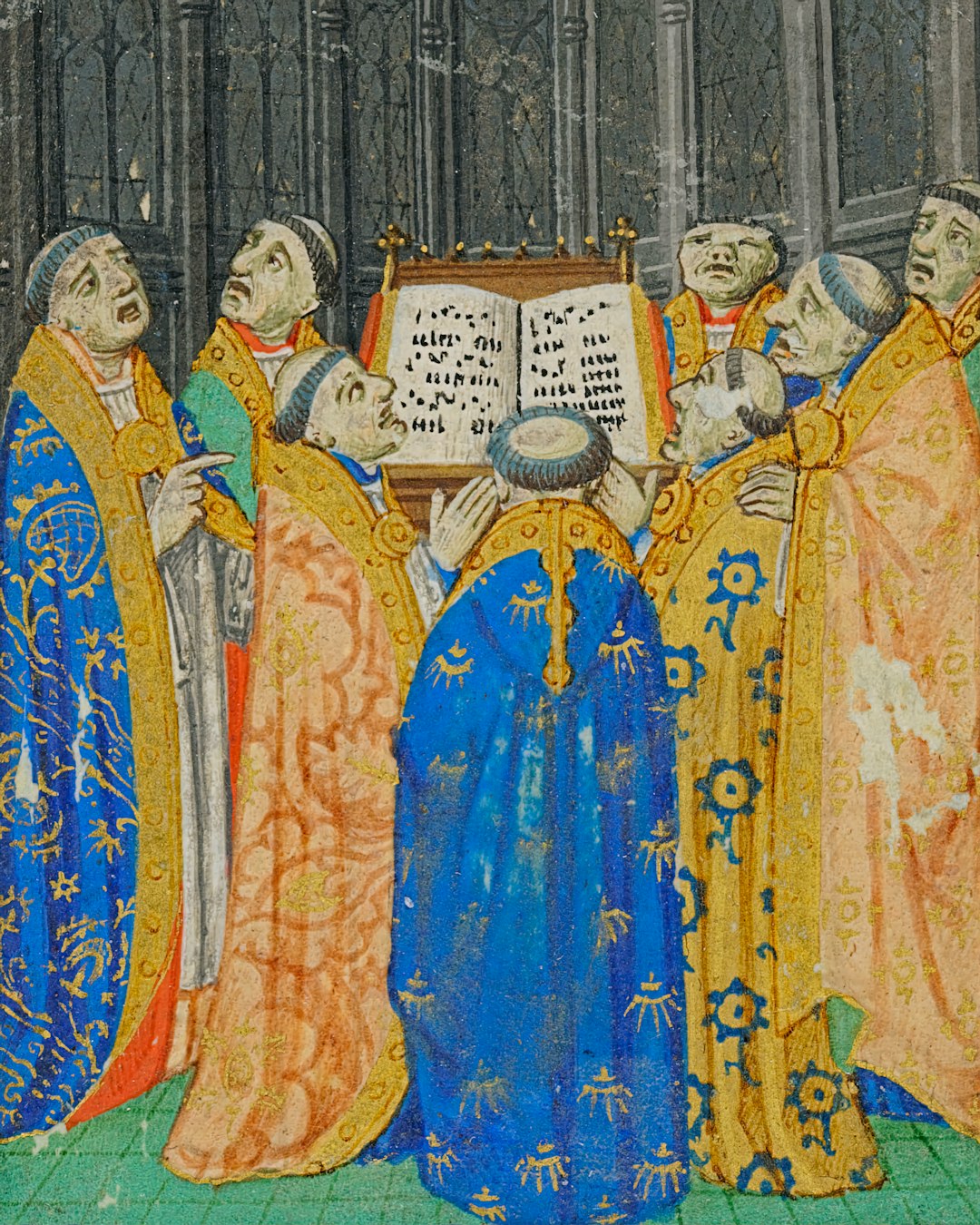
Medieval court scene reflecting the social and political context of early 14th-century Padua and the wealthy patronage that enabled great artistic commissions like the Scrovegni Chapel, c. 1305. Illumination. Public Domain.
The Architecture of Salvation
Giotto was not only a painter; he was also an architect. He designed the chapel itself — a simple rectangular building with a barrel vault, deliberately modest in its exterior appearance. The simplicity of the architecture serves the frescoes: the unadorned walls and ceiling become a canvas for the painted narrative, and the single nave creates an uninterrupted visual experience from the entrance to the altar.
The chapel was saved from destruction in the 14th century by a decree from the Eremitani monastery, which recognized its importance and took responsibility for its preservation. This early act of conservation ensured that the frescoes survived for over 700 years. A major restoration completed in 2002 removed centuries of accumulated grime and revealed the original brilliance of Giotto's colors — the deep ultramarine blue, the rich vermilion red, the luminous whites and golds that had been hidden beneath layers of soot and varnish. The restoration transformed our understanding of the chapel, revealing a work of art far more vibrant and sophisticated than anyone had imagined.
Why Giotto Matters
Giotto's achievement in the Scrovegni Chapel is not merely technical or aesthetic. It is philosophical. By painting figures who feel, who occupy real space, who express the full range of human emotion — from the tenderness of Joachim and Anna's embrace to the despair of the mourning angels — Giotto made a radical claim: human emotion is a fit subject for sacred art. The divine is not separate from the human; it is revealed through the human. Grief, love, betrayal, tenderness — these are not distractions from the sacred narrative; they are its essence.
This insight would shape the entire course of Western art. Every painter who came after Giotto — from Masaccio to Michelangelo, from Leonardo to Caravaggio — owed something to his revolution. He did not just paint better pictures than his predecessors. He changed what painting was for. And in the Scrovegni Chapel, on the walls of a banker's private chapel built on the ruins of a Roman arena in a small Italian city, he created a work of art that continues to move people to tears, seven centuries after the last brushstroke dried.