The Internet's Favorite Art (It Isn't Monet or Picasso)
Scroll through any art meme account on Instagram, Twitter, or Tumblr and you will not find Monet's water lilies or Picasso's cubist experiments. What you will find: killer rabbits attacking armored knights, snails jousting with humans, a nun picking penises from a tree, a butt-playing bagpiper, a cat with its front paws raised like it's saying "ta-da!"
These are not modern inventions. They are not ironic reinterpretations or digital art. They are real drawings from real medieval manuscripts, some over 700 years old, created by monks and scribes who presumably had better things to do than draw rabbits doing battle with fully armored knights. And yet, here we are — millions of people sharing medieval marginal art as memes, proving that the Middle Ages produced some of the funniest visual content in human history.
The question is: why? What is it about medieval art that resonates so perfectly with the internet's sensibility? And what were these images actually about — if anything?
The Greatest Hits of Medieval Weirdness
Before we get to the theories, let's meet the all-stars — the manuscripts that have provided the raw material for thousands of memes and millions of laughs.
The Luttrell Psalter (c. 1325–1335, British Library, Lincolnshire)
This is the undisputed heavyweight champion of medieval meme material. Commissioned by Sir Geoffrey Luttrell, a wealthy Lincolnshire landowner, this psalter (a book of psalms) contains some of the most bizarre marginal illustrations in all of medieval art. A knight in full armor fights a giant rabbit — and appears to be losing. In another margin, a rabbit drags a hound on a leash, reversing the normal hunting dynamic for comedic effect. A mermaid plays a lute. Two-headed creatures multiply across the pages. There are hybrid creatures that are part-human, part-animal, part-plant, part-nightmare.
What makes the Luttrell Psalter so funny is the contrast: the main text is solemn religious devotion, and the margins are an absolute carnival of absurdity. It's like opening a corporate annual report and finding doodles of monsters fighting accountants in the margins.
The Maastricht Hours (c. 1325–1350, British Library)
A Book of Hours (a personal prayer book) from the Netherlands, and another goldmine of marginal absurdity. A rabbit hunts a hound with a spear. A dog executes a monkey. A woman debates with a monkey (the monkey appears to be losing the argument). The absurdity is deliberate and sustained across dozens of pages — this isn't a one-off doodle, it's a running gag that the original artist committed to with the dedication of a sitcom writer building a season-long arc.
The Ormesby Psalter (c. 1310–1320, Bodleian Library, Oxford)
This manuscript contains the famous snail-vs-knight motif — an armored knight raises his sword against an approaching snail. The snail, for its part, appears to be advancing with what can only be described as menacing intent. This image appears in dozens of manuscripts across Europe, making it arguably the most reproduced meme template of the Middle Ages. The fact that multiple artists, in different countries, over several decades, kept drawing knights fighting snails tells you everything you need to know about medieval humor: they had in-jokes, and they were committed to them.
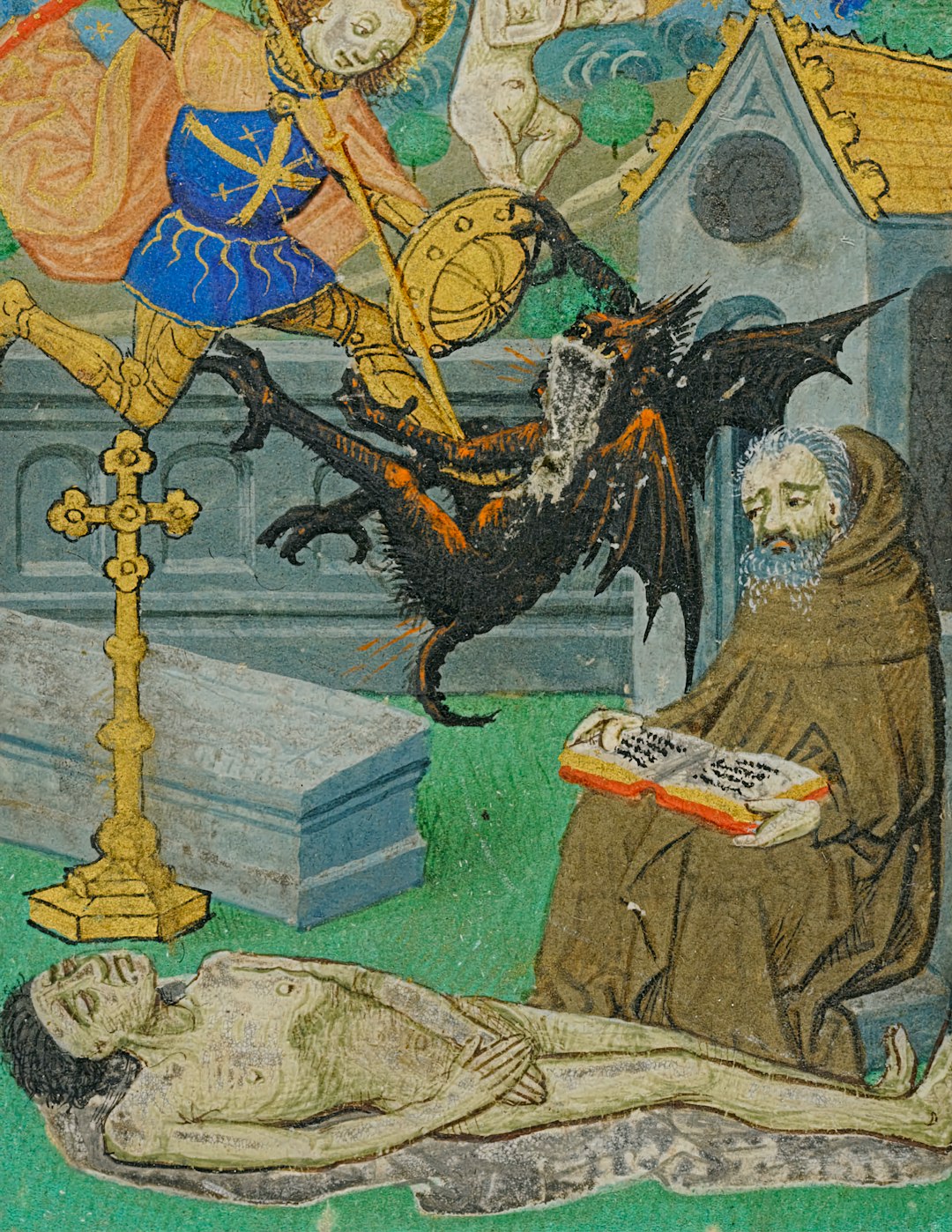
What Did They Mean? The Theories
Art historians have been debating the meaning of medieval marginalia for over a century, and there is no single agreed-upon answer. Here are the main theories — and they're not mutually exclusive.
Theory 1: Moral Warnings
Grotesques and absurd marginal drawings represented sin, chaos, and the grotesque nature of worldly life. Placed in holy books, they served as visual memento mori — reminders of what to avoid. The killer rabbit wasn't just funny; it was a warning about the chaos that ensues when the natural order is overturned. The snail, slow and slimy, represented cowardice (snails were associated with cowardice in medieval bestiaries) — so a knight fighting a snail was a satire of cowardly combat, or perhaps a warning against fighting unworthy opponents. The absurdity was the point: it showed how ridiculous and disordered sin appears when held up to the light of reason.
Theory 2: Carnival Culture
Medieval Europe had festivals — Carnival, the Feast of Fools — where social roles were deliberately reversed. Peasants became kings, kings became fools, donkeys were led into churches and given bread and wine. This "world turned upside down" (monde renversé) tradition was a sanctioned outlet for social tension, a pressure valve that allowed people to laugh at authority by temporarily inverting the hierarchy. Marginal art may be this tradition rendered in ink and pigment. The rabbit hunting the hound, the snail defeating the knight, the animal executing the human — these are visual carnival, the hierarchy overturned for the amusement of the reader.
Theory 3: Entertainment
This is the "bored monk" theory, and it's the one that makes the most intuitive sense. Copying manuscripts was monotonous work. Hours of carefully replicating text, letter by letter, word by word, day after day. It's entirely plausible that scribes drew weird stuff to amuse themselves — and, perhaps more importantly, to amuse future readers. Modern scholars like Michael Camille have argued that marginalia was a form of creative rebellion within a strict system. The main text had to follow precise rules, but the margins were free space — a place where the scribe's imagination could run wild. In this reading, marginalia is medieval graffiti: unofficial, unsanctioned, and deeply human.
Theory 4: Subconscious Expression
Like Surrealist automatic drawing, marginalia may represent the unfiltered imagination — dream logic applied to parchment. When the conscious mind is occupied with the mechanical task of copying text, the subconscious is free to produce whatever images arise. The result is a visual stream of consciousness: hybrids, transformations, impossible creatures, and scenes that operate by the logic of dreams rather than the logic of waking life. This theory has gained traction with psychologists and art historians who see parallels between medieval marginalia and the work of 20th-century Surrealists like Max Ernst and Joan Miró.
The "Medieval Reacts" Phenomenon
The modern medieval meme movement owes an enormous debt to a Tumblr blog called "Medieval Reacts," which was active from roughly 2012 to 2016 and continues to exert massive influence on Twitter, Instagram, and TikTok. The blog's formula was simple and brilliant: take a weird medieval image and pair it with a contemporary caption that made it relatable to modern internet users.
A medieval face of horror became "When you open the front camera by mistake." A painting of a monk pointing became "When you're trying to explain something but the other person isn't listening." A drawing of a cat sitting at a desk became "Me pretending to work from home." The juxtaposition of 700-year-old art with 21st-century internet speak created a comedic effect that was both unexpected and instantly recognizable.
The blog went viral. It was shared by major media outlets, quoted by academics, and viewed by millions. It proved that medieval art speaks to the internet's sensibility perfectly — perhaps because the internet, like the medieval margin, is a space where anything can happen, where high and low culture collide, where the sacred and the profane sit side by side.
Why Medieval Memes Resonate
Medieval art memes are funny. That's the most honest answer. But they're also doing something more important than making us laugh — they're shattering one of the most persistent stereotypes in popular culture: the idea of the "dour Middle Ages," the notion that medieval people were grim, humorless, obsessed with death, and lived in a perpetual state of religious gloom.
The truth is radically different. Medieval people had a wild, bizarre, irreverent, deeply strange sense of humor. They told dirty jokes (the fabliaux — short comic tales — are full of them). They played pranks. They wrote satirical poems about their neighbors. And they drew absolutely ridiculous things in the margins of their most sacred books.
The gap between the solemnity of a psalter and the absurdity of its marginal drawings is precisely what makes it funny. A Book of Hours is one of the most sacred objects in medieval culture — a personal prayer book used for daily devotion. Finding a drawing of a knight being defeated by a rabbit in its margins is the medieval equivalent of opening a corporate mission statement and finding a doodle of the CEO fighting a giant hamster. The contrast is the comedy.
And perhaps that's the deepest reason medieval memes resonate: they remind us that humor is not a modern invention, that the urge to find absurdity in the solemn, to laugh at authority, to draw silly things in serious places — this is not unique to the internet age. It's human. It's always been human. The monks who drew killer rabbits were not so different from the office worker who doodles during a meeting. The scribes who filled margins with snail knights were not so different from the student who sketches monsters in their textbook. The impulse is the same across seven hundred years.
So the next time you see a medieval art meme — a rabbit jousting with a knight, a snail advancing with purpose, a cat with its paws raised in triumph — take a moment to appreciate the real history behind the joke. These are not just funny pictures. They are windows into the minds of real people who lived, worked, laughed, and doodled their way through the Middle Ages. And if anything proves that the past is not a foreign country, it's the fact that a 700-year-old drawing of a rabbit fighting a knight can still make you spit out your coffee.
A Final Thought: The Margins Are Where the Fun Is
There's a broader lesson here, one that extends beyond medieval art and internet humor. The margins of medieval manuscripts — the spaces between the sacred text and the edge of the page — were where the real personality of the medieval world lived. The main text was formal, rule-bound, serious. But the margins? The margins were free. In the margins, scribes drew what they wanted. They expressed what couldn't be expressed in the formal text. They created a parallel world of humor, fantasy, and subversion that existed alongside — and commented on — the official culture.
Every culture has its margins. Every system has its unofficial spaces where the real personality leaks through. Medieval art memes are a reminder to look at the margins — in history, in art, in life — because that's often where the most interesting things are happening. And that's where the rabbits are waiting to fight the knights.
Related Reading
- → The Book of Kells: The Most Beautiful Manuscript in the World — A serious counterpart to the absurd marginalia discussed here.
- → Byzantine Art (4th–15th Century) — The gold-ground mosaics of the Eastern Roman Empire.
- → Gothic Art (12th–15th Century) — The soaring cathedrals and luminous sculpture of Western medieval Europe.
- → About History Canvass — Learn more about our mission to make medieval art accessible.
Frequently Asked Questions
References
Bakhtin, Mikhail. Rabelais and His World. Indiana University Press, 1984.
Camille, Michael. Image on the Edge: The Margins of Medieval Art. Reaktion Books, 1992.
Camille, Michael. Mirror in Parchment: The Luttrell Psalter and the Making of Medieval England. University of Chicago Press, 1998.
Harbison, Craig. The Art of the Northern Renaissance. Phaidon Press, 1995.
Kendrick, Laura. Chaucering Chaucer: The Impersonation of the "Writer" in the Canterbury Tales. University of California Press, 1996.
Michael, Camille. "The Grotesque: Monsters and Marginalia in Medieval Art." Art History, vol. 15, no. 1, 1992, pp. 1-32.